 Skip to content
If you are planning to build a mobile application for your business in 2026, one of the first — and most important — decisions you will make is which development framework Flutter vs React Native to use. For the majority of business app projects, the choice comes down to two leading cross-platform options: Flutter and React Native.
Both frameworks allow you to build apps that run on both iOS and Android from a single codebase — dramatically reducing development time and cost compared to building native apps separately for each platform. But they differ significantly in their architecture, performance characteristics, ecosystem maturity, and ideal use cases.
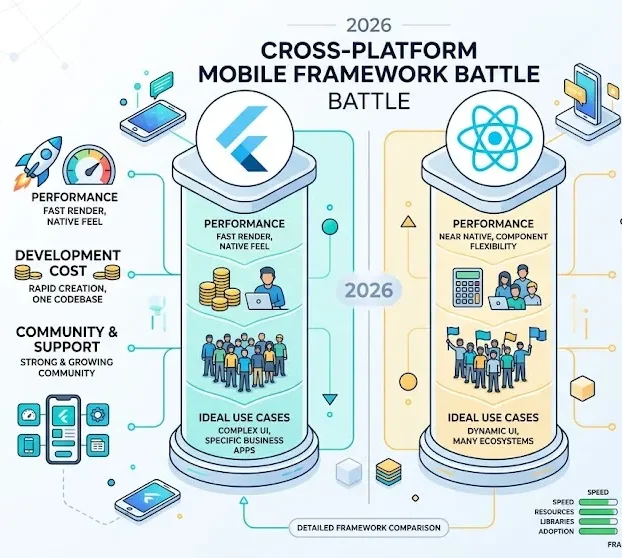
Flutter: Google’s Fast-Growing Framework
Flutter was created by Google and uses the Dart programming language. Rather than relying on native UI components, Flutter renders its own widgets — which means the app looks and behaves consistently across platforms, including iOS, Android, web, and desktop. This rendering approach also delivers excellent performance, with smooth 60fps animations even on lower-end devices.
Flutter’s widget library is extensive and beautifully designed, enabling high-quality UI development with relatively little custom work. The framework has seen explosive growth in adoption since 2021 and now has one of the largest and most active developer communities in mobile development.
React Native: Meta’s Battle-Tested Framework
React Native was created by Meta (Facebook) and uses JavaScript — the world’s most widely used programming language. Rather than rendering custom widgets, React Native bridges to native UI components, which means apps built with it look and feel native on each platform.
React Native’s primary advantage is its enormous JavaScript/React developer community and ecosystem. If your business already has web developers working in React, their skills transfer directly to React Native, reducing onboarding costs and expanding your available talent pool significantly.
Head-to-Head Comparison
Performance
Flutter generally has the edge on raw performance and animation smoothness, particularly for graphics-intensive applications. React Native’s JavaScript bridge can introduce occasional performance overhead, though the recently introduced New Architecture (JSI) has significantly narrowed this gap.
UI Consistency vs Native Feel
Flutter provides pixel-perfect consistency across platforms. React Native provides more native platform feel — iOS apps look iOS-native, Android apps look Android-native. The right choice depends on your brand and UX priorities.
Development Speed and Cost
Both frameworks offer significant cost savings over native development. Flutter is often slightly faster for green-field projects due to its comprehensive widget library. React Native has an advantage when your team already has React experience.
Ecosystem and Community
React Native’s JavaScript ecosystem is larger and more mature. Flutter’s ecosystem is growing rapidly and now has excellent coverage for most common mobile app requirements.
Which Should Your Business Choose?
Choose Flutter if: you are building a visually rich, performance-critical application; you do not have existing JavaScript/React expertise; or you want the most consistent cross-platform UI experience. Choose React Native if: your team already uses React; your app needs to feel truly native on each platform; or you want access to the largest available developer talent pool.
Techcited Ltd’s Mobile App Development Expertise
Techcited Ltd specialises in Flutter mobile app development, delivering high-quality, performant iOS and Android applications for businesses across the UK. Our experienced Flutter team has delivered apps across sectors including retail, healthcare, professional services, and logistics.
Frequently Asked Questions
Q: Can a Flutter or React Native app match the performance of a native app?
A: For the vast majority of business application use cases — forms, data display, user authentication, notifications, payments — yes. Only highly performance-critical applications such as advanced graphics, real-time gaming, or heavy device sensor integration might require truly native development.
Q: How much does it cost to build a mobile app in the UK in 2026?
A: A straightforward business app with standard features (user authentication, data display, push notifications) typically costs £15,000–£40,000 depending on complexity. Contact Techcited Ltd for a specific estimate based on your requirements.
Q: Does Techcited Ltd publish both iOS and Android versions of apps built with Flutter?
A: Yes. Flutter builds to both iOS (App Store) and Android (Google Play) from a single codebase. We manage the submission and publication process for both platforms as part of our app development service.
Ready to get started?
Thinking about building a mobile app for your business? Techcited Ltd’s Flutter development team is ready to help. Book a free project consultation today. Visit: it.techcitedltd.co.uk
